EU regulations set out requirements for physical and operational resilience
The new CER (Critical Entities Resilience) Directive requires energy companies to protect their facilities against incidents such as explosions, sabotage and extreme weather.
The aim is clear: to protect people, the environment and operational safety.
Who is covered?
The Directive applies to companies providing critical services within the energy sector, including:
Electricity generation and transmission (TSO/DSO)
District heating and gas distribution
Fuel storage facilities and terminals
Large-scale renewable energy plants
If your company is part of the supply chain, the law may apply to you.


What does the CER Directive mean in practice?
Businesses must be able to document:
Risk assessment of buildings and technical installations
Physical protective measures (explosion protection, security film, access control)
Contingency and recovery plans
It is not just about legal requirements – but about resilience and safety for staff and operations.
Should we replace the entire infrastructure, or is there a smarter solution?
Many businesses fear that the new requirements will mean major investment and the replacement of entire façades or window systems.
Fortunately, this is rarely necessary.
For most energy companies, the requirements can be met through upgrades rather than complete refurbishments.
In this context, safety film and specialist glass are the most effective solutions:
1. Quick installation – without any downtime
Safety film can be fitted directly onto existing windows, even in facilities that are fully operational.
This means that the building can be reinforced in a matter of hours or days, without affecting production.
2. Cost-effective upgrade
Instead of replacing entire window systems (which often costs millions), businesses can opt for a certified safety film that:
Increases resistance to explosions and shock waves
Reduces the risk of flying glass
Enhances the building’s resistance to vandalism and break-ins
All at a fraction of the cost.
3. Proven effectiveness
Modern security films are tested to international standards (e.g. EN 12600 and bomb blast tests).
They are currently used in critical buildings across Europe.
4. Expertise through strong partnerships
As a partner of Nordisk Glas Security, Optinor offers access to some of the most experienced specialists in industrial security and the protection of critical infrastructure.
This means you get:
Professional advice
Compliance documentation
Certified solutions installed correctly first time
When did the CER Directives come into force?
Publication and entry into force
The CER Directives were adopted by the EU in December 2022.
Member States must transpose the Directives into national law by 17 October 2024 at the latest.
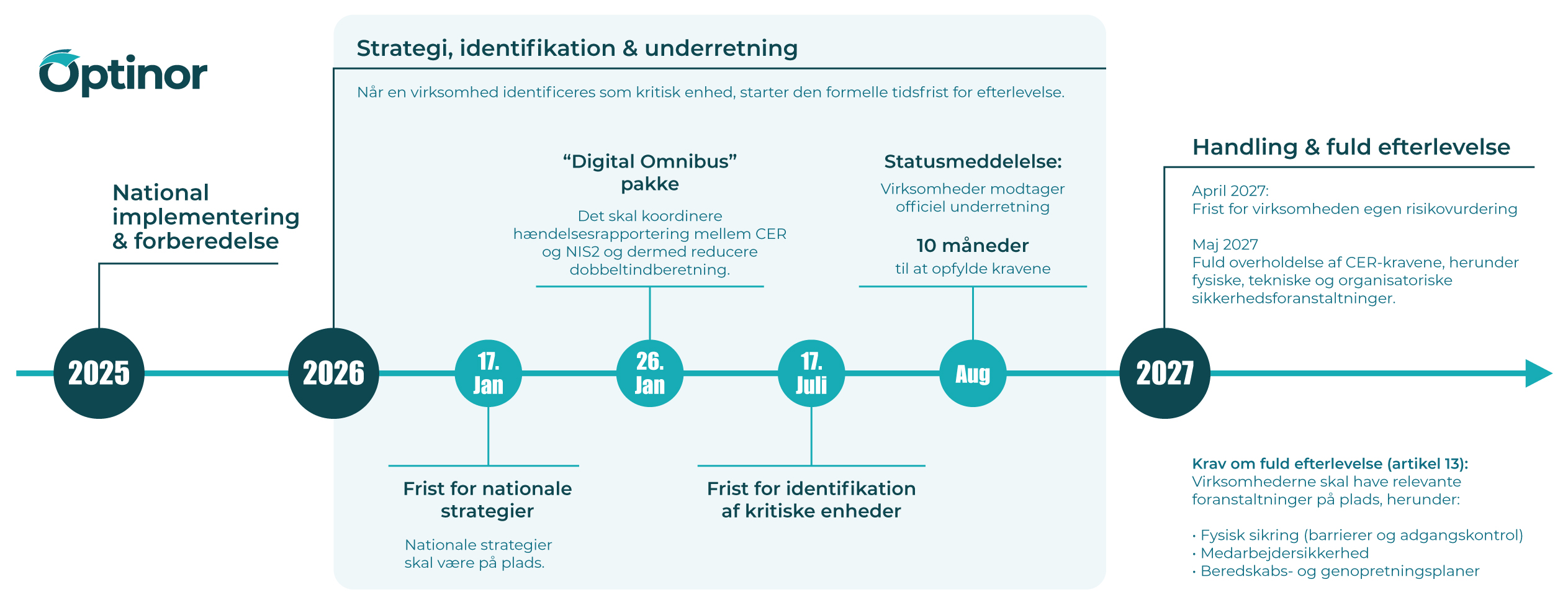
- 2025 – National implementation & preparation: July 2025: The CER legislation comes into force in Denmark.
The requirements will come into force gradually leading up to 2026, the ‘trigger year’.
This is the most critical year for businesses. Once a business is identified as a critical entity, the regulatory deadline for upgrading its resilience and security begins.
Below you will find a clear timeline providing an overview of when businesses should prepare and take action in connection with the implementation of the CER Directive in Denmark and the EU.